The MLOps Adventure Continues: An AGENTS.md Ready Stack for AI/ML
AI coding agents amplify repository friction. How we redesigned an MLOps codebase around deterministic single-command gates, SQLite isolation, and AGENTS.md.
- Coding
- MLOps
- Guide
With your consent, Google Analytics measures which pages help visitors so I can improve them.
Nothing loads before you accept, and you can change your choice from the footer at any time. Privacy
Writing
Pragmatic field notes on AI agents, MLOps, cloud architecture, and engineering systems.
Get new articles in your feed reader. Copy the RSS link into your reader to subscribe.
AI coding agents amplify repository friction. How we redesigned an MLOps codebase around deterministic single-command gates, SQLite isolation, and AGENTS.md.
Bridge the gap between engineering specs and AI agents using Agent Skills. Learn to inject ‘Senior Engineer’ context for production MLOps.
Building AI applications is incredibly exciting. But let’s be honest: getting started can be challenging, especially in large organizations.
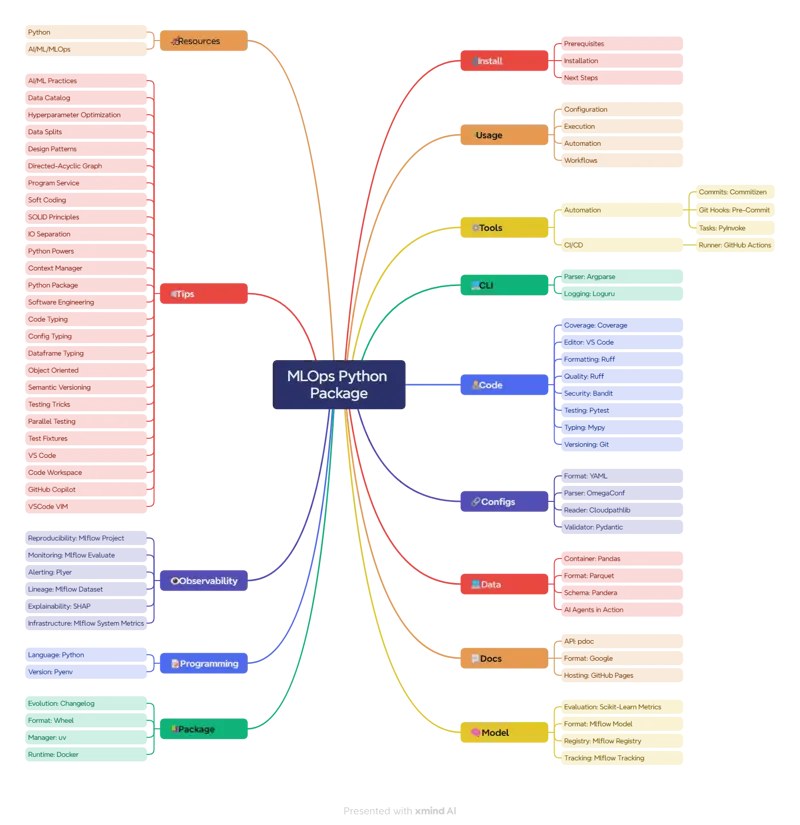
The MLOps Python Package is your go-to solution for building robust and reproducible AI/ML workflows. Check out the latest v4.1.0 release!
MLOps pipelines are often too rigid. We propose using reusable artifacts orchestrated by DAGs. Think functional programming for ML!
Poetry vs uv from a real migration: how I moved the MLOps Python Package to uv, with the pyproject.toml, CI, and Docker changes, and why builds got faster.
The Cookiecutter MLOps Package offers a powerful code template to jumpstart your MLOps journey and accelerate your AI/ML development.
This article dives deep into the essential tools and practices for achieving comprehensive observability in your AI/ML projects.
The MLOps Coding Course is an open-source resource specifically designed to bridge the gap between data science and software engineering.
A method to build robust yet flexible MLOps code bases with Python's ABC and Pydantic, grounded in design patterns and the SOLID principles.
The MLOps ecosystem is evolving into a sophisticated symphony, composed of diverse tools, methodologies, and cultures.
Programmers have always been passionate about their preferences, whether they discuss spaces vs. tabs, Vim vs. Emacs, or light mode vs. dark mode.
While the future of machine learning and MLOps is being debated, practitioners still need to attend to their machine learning models in production.
MLOps practitioners (rightfully) point out that running notebooks in production is a bad software practice, but what are the alternatives?
How I used the ChatGPT API to standardize the open-ended answers of the MLOps Community survey on LLMs in production, and the lessons I learned.
There is an ever-growing landscape of tools and solutions for MLOps. In this article, I propose a solution to address this challenge.